Home /
Zinc Picolinate (ZP-99) /
Latest Insights
Preventing OEM Batch Failures: Mastering Capillary Bridging and Particle Adhesion in Hygroscopic Zinc Picolinate
📅 September 22, 2026
🏷️ Technical Insights
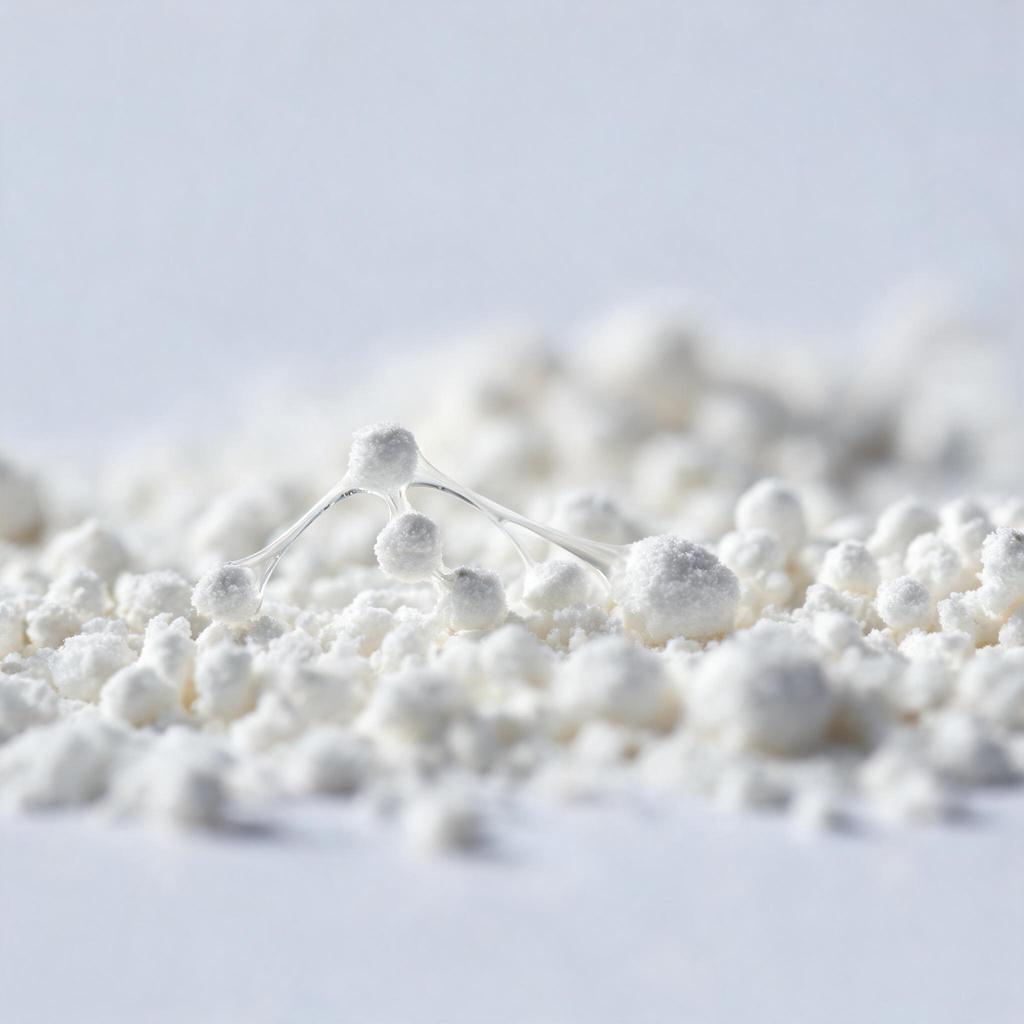
The Invisible Enemy in High-Speed Filling: Capillary Bridging in API Powders
For global OEM and ODM manufacturers, the transition from lab-scale formulation to industrial mass production is often plagued by a single, elusive variable: powder rheology. When dealing with highly bioavailable organic chelates like our premium-grade Zinc Picolinate (CAS 17949-65-4), formulators frequently encounter unexplained downtime in high-speed capsule filling machines or catastrophic caking during long-term storage.
The root cause is rarely a manufacturing defect; it is almost always the physics of capillary bridging and particle adhesion.
As a B2B supplier committed to supply chain reliability, LumenAxys™ understands that an active ingredient is only as valuable as its processability. This technical deep-dive explores the thermodynamics of liquid bridge formation, why hygroscopic zinc salts are uniquely susceptible, and the precise engineering controls required to maintain powder flowability.
The Physics of Cohesion: Surface Tension and Laplace Pressure
To prevent batch failures, we must first understand the forces at play. A capillary bridge is a minimized surface of liquid created between two rigid bodies—in this case, micro-crystalline Zinc Picolinate particles. The magnitude of the adhesive force holding these particles together is dictated by two primary factors: surface tension and Laplace pressure.
- Surface Tension: The intermolecular force acting at the liquid-gas interface, tending to minimize surface area. In a powder bed, this acts along the contact line where the liquid meets the solid particle.
- Laplace Pressure: The pressure difference between the interior and exterior of the liquid caused by the curvature of the liquid's surface. It acts on the contact surface of the particles.
When ambient humidity introduces even trace amounts of water into a bulk fluid suspension of powders, the addition of this secondary fluid can dramatically alter the rheological properties of the mixture. The system transitions from a fluid-like state to a gel-like state, increasing yield stress and viscosity by several orders of magnitude. This phenomenon—known as capillary suspension—is the exact mechanism that causes your hopper to jam.
Why Organic Chelates Like Zinc Picolinate Are Vulnerable
Inorganic zinc salts are relatively stable, but organic chelates present a distinct challenge. Zinc Picolinate features a pyridine carboxylate ligand coordinated to a Zn2+ ion. While this coordination provides superior intestinal absorption via hPepT1 transporters, it also leaves polar functional groups exposed on the crystal lattice.
These polar sites act as nucleation centers for atmospheric moisture. If the Loss on Drying (LOD) exceeds the critical threshold (typically > 4.0%), the moisture migrates to the particle interfaces. Here, the pendular state of capillary suspensions takes effect: individual particles are linked through capillary bridges, forming dimers and trimers that eventually agglomerate into large clusters.
Industry Reality Check: A 0.5% increase in LOD can double the cohesive energy of the powder bed. For a direct compression (DC) tablet press, this means severe die fill issues and weight variation exceeding ±8%. For a rotary pill machine, it means continuous jamming at the feed track.
Engineering Solutions: Breaking the Capillary Bridge
At LumenAxys™, we do not just ship raw materials; we engineer solutions for your processing lines. To mitigate capillary bridging and ensure consistent particle adhesion profiles, we implement a multi-tiered quality control matrix:
1. Thermogravimetric (TGA) Moisture Control
We rigorously validate every lot using Thermogravimetric Analysis to ensure the Loss on Drying remains strictly below 4.0%. By controlling the absolute moisture content, we keep the saturation level S close to zero, preventing the system from entering the pendular state where strong gels form.
2. Optimized Particle Size Distribution (PSD)
Capillary force is inversely proportional to particle size. Smaller particles have a higher surface-area-to-volume ratio, making them more susceptible to adhesion. Our proprietary micronization process ensures a uniform PSD with a median diameter optimized for high-speed capsule filling. We avoid the "fines" fraction (< 10 µm) which is most prone to Van der Waals cohesion and capillary locking.
3. Anti-Caking Agents & Packaging Integrity
We utilize food-grade, non-reactive anti-caking agents (such as colloidal silicon dioxide) in specific grades to physically disrupt the formation of liquid bridges. Furthermore, all shipments are sealed in nitrogen-flushed, multi-layer aluminum foil pouches with desiccant packs to maintain a relative humidity (RH) environment below 30% during transit.
B2B Procurement FAQ: Addressing OEM Formulation Bottlenecks
Q1: How does high ambient humidity affect my Zinc Picolinate inventory?
A: Even if stored in a climate-controlled room, opening a drum exposes the powder to transient RH spikes. This triggers rapid moisture adsorption onto the polar pyridine rings. Within hours, capillary bridges form, causing the powder to lose its angle of repose and become "caked." Always transfer material in low-humidity environments or use a closed pneumatic conveying system.
Q2: Can I add a binder to fix poor flowability caused by adhesion?
A: No. Adding a binder will exacerbate the problem by increasing the liquid volume fraction, pushing the system further into the capillary state (strong gel). The correct approach is to reduce the moisture content of the API itself and ensure proper sieve mesh sizing before blending.
Q3: What is the acceptable Assay and Purity profile for your Zinc Picolinate?
A: All LumenAxys™ batches meet USP/EP standards with an Assay ≥ 99.0%. We employ sub-ppb ICP-MS validation to guarantee heavy metals (Pb, As, Cd, Hg) are well below California Prop 65 limits, ensuring your final supplement label remains compliant globally.
Q4: Does your powder exhibit electrostatic clumping in addition to capillary bridging?
A: While electrostatic forces exist, they are negligible compared to capillary forces when moisture is present. Our anti-static packaging and controlled drying process minimize charge accumulation, ensuring that the dominant force governing your powder's behavior is predictable and manageable.
